
Multi-UAS Persistent Hurricane Coverage – Black Swift Technologies
3851wp-singular,page-template-default,page,page-id-3851,wp-custom-logo,wp-theme-bridge,bridge-core-2.7.3,eio-default,,qode_grid_1400,footer_responsive_adv,qode-theme-ver-25.8,qode-theme-bridge,disabled_footer_bottom,wpb-js-composer js-comp-ver-9.0.1,vc_responsive,elementor-default,elementor-kit-2395,elementor-page elementor-page-3851

Beyond the Dropsonde
Distributed Hurricane UAS Sensing
Multi-Drone Persistence IN the Boundary Layer
Scalable hurricane UAS sensing is here. Black Swift Technologies captures real-time latent heat flux data to solve the mystery of rapid storm intensification.
Published April 3rd, 2026
1. First Simultaneous Multi-UAS Deployment for Hurricane Research
2. Solving the Human-Factor Bottleneck in UAS Swarm Management
3. Correcting Physics Errors: Collecting Critical Air-Sea Flux Data
4. Technical Authority (FAQ)
From inside the Hurricane Hunter's P-3 Orion, the S0 is deployed. Watch this record-breaking UAS capture first-ever footage from within a tropical cyclone. Footage captured from Hurricane Melissa.
Video Credits to: National Oceanic and Atmospheric Administration
The Shift to Scalable Persistence
First Demonstration of Scalable Distributed Sensing for Hurricane Forecasting


Engineered to survive in Category 5 winds, the S0 is now mission-ready for multi-UAS hurricane boundary layer sensing.
Powered by the AI-enabled SwiftCore FMS, our architecture reduces operational burden, making it seamless to scale for persistent atmospheric coverage.
With record-breaking, uninterrupted communication ranges, the multi-UAS drop transforms how we sample the hurricane engine room.
This accomplishment represents a fundamental shift in atmospheric sampling. Instead of relying on traditional dropsondes which only provide a momentary, rapid vertical profile as they fall to the ocean, the deployment of multiple overlapping drones allows for "scalable persistence" within the hurricane boundary layer. By successfully demonstrating this scalable concept, BST has paved the way for future operations to deploy 5 to 10 or more systems in a single mission, establishing a path toward continuous, uninterrupted coverage of a storm.
Request additional technical information:
Any Mission. Our Solution.
1. Hurricane and extreme weather research
2. Numerical weather prediction development
3. Operational forecasting and emergency response
Reducing Operational Burden
Solving the Human-Factor Bottleneck in UAS Swarm Management
Recent operations at the Lakeland facility successfully addressed the human-factor bottleneck traditionally associated with task saturation in multi-UAS missions. By utilizing a streamlined operational interface, a single station was used to deploy and manage two S0 drones simultaneously.
This intuitive control system, integrated with sensor-reactive automation, allows operators to define high-level objectives such as locating and measuring maximum wind speeds. Technical overhead is significantly reduced, enabling a single pilot to conduct complex, multi-vehicle missions with greater efficiency and precision.

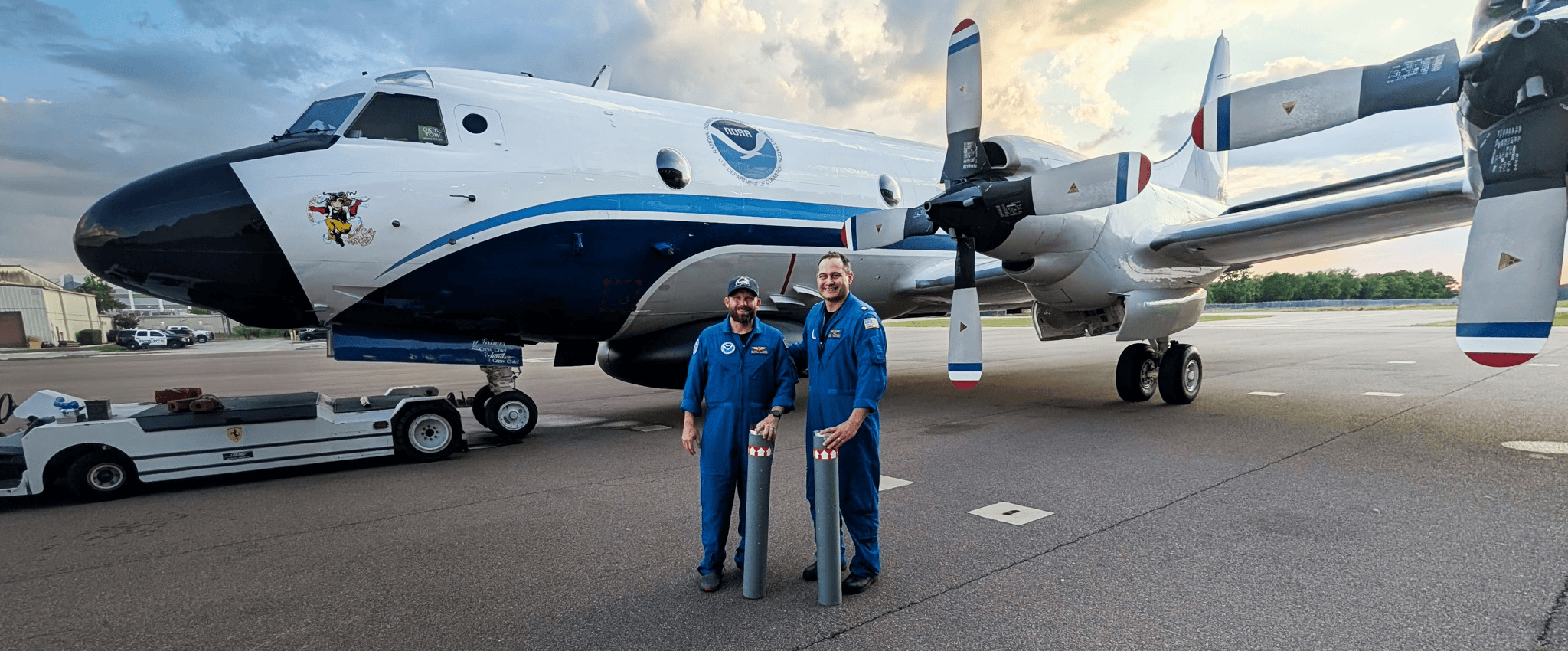
NOAA aircrew members inside a WP-3D Orion aircraft monitor the Operational UI during a Black Swift S0 multi-UAS drop and validation mission.
This unified command structure proved that multiple unmanned assets can be managed in a highly active, chaotic flight environment without increasing the operational burden or risk to the aircrew. Furthermore, the flights validated the underlying multi-aircraft communications and deconfliction protocols in a practical, real-world setting, confirming that the swarm architecture is fully ready for complex deployments.
Mapping the Engine Room
Enabling Forecasting: Collecting Critical Air-Sea Flux Data
Characterizing the Atmospheric Boundary Layer (ABL) is essential for understanding tropical cyclone intensification. The ABL is the primary region where a storm absorbs heat and moisture from the ocean, a critically under-researched region that holds valuable insights into rapid intensification. Traditional sensors, such as dropsondes, provide only brief vertical snapshots, which are insufficient for measuring the continuous energy exchanges that drive storm strength.
The Black Swift S0 UAS enables persistent, low-altitude sensing to resolve these data gaps. By maintaining flight at altitudes as low as 20 to 30 feet for up to two hours, the S0 facilitates the continuous collection of high-resolution data within the storm environment.
In-Situ Flux Quantification
The S0 utilizes the Multi-Hole Pressure Probe (MHPP) to capture high-frequency measurements of 3D wind vectors, pressure, temperature, and humidity. Currently, the Black Swift Multi-Hole Pressure Probe (MHPP) is the only active small UAS instrument capable of taking measurements of high enough quality and capable of real-time measurements in heavy precipitation to calculate these exchange coefficients.
- Momentum Flux: Physical force transfer between wind and water.
- Sensible Heat Flux: Heat transfer due to temperature gradients.
- Latent Heat Flux: Energy transfer via moisture evaporation.

The MHPP provides the precision required to calculate specific surface exchange coefficients at extreme wind speeds.
Want to learn more about our specialized MHPP? Contact us today:
Enhancing Forecast Model Accuracy


